Table of Contents
Climbing grades can be confusing for newcomers. Understanding the Yosemite Decimal System helps you choose appropriate routes and track your progression.
Jordan Myers
Climbing grades can be confusing for newcomers. Understanding the Yosemite Decimal System helps you choose appropriate routes and track your progression.
Climbing grades can be confusing for newcomers. Understanding the Yosemite Decimal System helps you choose appropriate routes and track your progression.
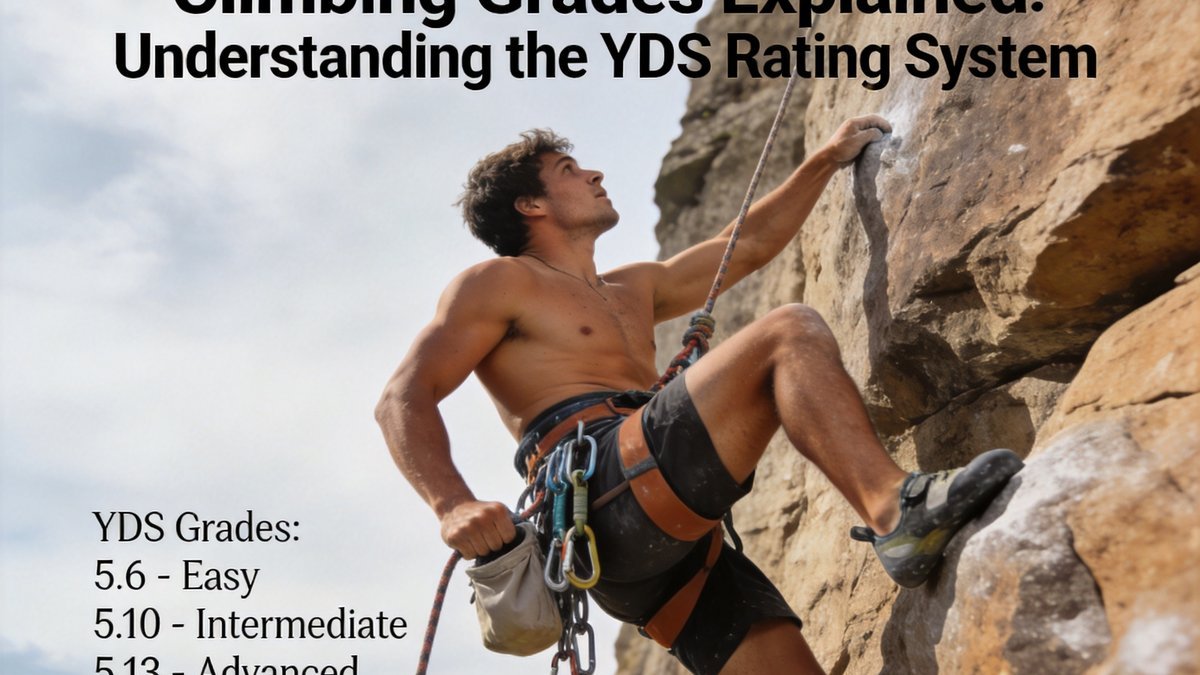
The Yosemite Decimal System was developed in the 1950s by the Sierra Club to classify hiking and climbing terrain. Classes 1 through 4 cover non-technical terrain from flat walking to exposed scrambling requiring hands. Class 5 describes technical rock climbing where ropes and protection are standard practice. This system has become the standard for rock climbing grades in North America.
Class 5 climbing is subdivided into decimal increments from 5.0 to 5.15. Early climbers believed 5.9 represented the absolute limit of human climbing ability. When routes harder than 5.9 were established in the 1960s, the system expanded to add letters: 5.10a through 5.10d. Today the scale extends to 5.15d, with each letter grade representing a significant increase in difficulty.
The system is open-ended by design. As climbers push human limits, new grades can be added. Each full number grade from 5.10 upward contains four sub-grades: a, b, c, and d. For example, 5.11a is easier than 5.11b, which is easier than 5.11c, and so on. The difference between sub-grades is roughly equivalent to the difference between full number grades at lower levels.
Climbing grades represent the consensus opinion of the climbing community about a route's difficulty. When a new route is established, the first ascent party proposes a grade based on their experience climbing other routes. Subsequent ascents confirm or adjust the grade. Routes may be upgraded or downgraded over time as more climbers provide feedback.
Multiple factors influence a route's grade. Technical difficulty of the hardest move is the primary factor but not the only one. Sustained difficulty, physical demands, mental challenge, and route-finding complexity all contribute. A route with one very hard move may receive the same grade as a route with sustained moderate difficulty throughout its entire length.
Grade inflation and regional variation are real phenomena. Grades in well-traveled areas like the Gunks and Yosemite tend to be stiffer than grades at newer climbing areas. Gyms are notorious for soft grading that makes climbers feel stronger indoors than they actually are outdoors. A 5.10a gym route might climb more like a 5.8 or 5.9 at a traditional outdoor crag.
The V-scale, created by John Bouchard in the 1950s, rates bouldering problems from V0 to V17. V0 represents the easiest problems requiring basic climbing movement skills. Each full grade increase represents a significant jump in difficulty. Bouldering grades are compressed compared to roped climbing grades: a V4 boulder problem is roughly equivalent in difficulty to the hardest move on a 5.12 sport route.
Bouldering grade ranges correspond to experience levels. V0-V2 is beginner territory achievable within the first few months of climbing. V3-V4 is intermediate requiring good technique and moderate finger strength. V5-V7 is advanced requiring significant strength, power, and climbing experience. V8 and above is elite territory requiring years of dedicated training.
Bouldering grades feel different from route grades because bouldering measures peak power on individual moves. A climber comfortable on V4 boulders may struggle on V5 for weeks or months. The exponential increase in difficulty means each V-grade jump is larger than the previous one. Progress in bouldering requires consistent effort and intelligent training.
Grade interpretations vary significantly between climbing areas. The Shawangunks in New York are famous for stiff grades where 5.8 feels like 5.9 elsewhere. Rifle Mountain Park in Colorado is known for steep, powerful climbing at every grade. The Red River Gorge in Kentucky offers generous grades that feel easier than similarly rated routes elsewhere.
International grade conversions add another layer of complexity. The French grading system is widely used in Europe and South America. French grades use numbers with letters: 4a, 4b, 4c, 5a, 5b, 5c, 6a, and so on upwards. A French 6a roughly corresponds to YDS 5.10a. The UIAA system uses Roman numerals common in Germany and Austria. Understanding these systems is essential for international climbing trips.
British grades use a unique technical grade plus adjective grade system. The technical grade describes the hardest move, while the adjective grade describes the overall seriousness including difficulty, exposure, and commitment. A route graded VS 4c combines these elements. British trad grades prioritize accurate risk assessment alongside pure difficulty.
Grades are most useful for route selection when combined with knowledge of the specific area and your personal strengths. A climber who excels on steep, powerful routes may perform above their grade on vertical face climbing. A technique-focused climber may climb harder on slabs than on overhangs. Know your climbing style and adjust route selection accordingly.
Use grades to track personal progress but avoid obsessing over them. Comparing your grades to other climbers is counterproductive and discouraging. Everyone progresses at different rates based on genetics, training consistency, climbing frequency, and access to different types of terrain. The most important measure of climbing success is whether you enjoy the experience.
Grades serve a practical purpose in risk management. Climbing at or slightly below your limit grade on unfamiliar terrain reduces accident risk. Always warm up on routes two to three grades below your limit. On trad climbs, the protection grade matters as much as the technical grade. A technically easy route with poor protection may be more dangerous than a harder route with bomber gear.
"Grades are opinions, not facts. A route that feels like 5.9 on a hot, humid day might feel like 5.7 on a cool, dry morning with perfect conditions. Do not let a number dictate whether you try a route. The only way to know if a climb suits you is to get on the rock."
"The most important grade in climbing is the fun grade. A classic 5.6 route with exposure, position, and interesting movement is a better climb than a contrived 5.12 route that nobody enjoys. Seek quality over difficulty and your climbing experience will be richer."
Start by climbing routes two to three grades below what you think you can handle. Warm up on easy routes and gradually increase difficulty. Your comfortable on-sight grade is the level where you can climb a route on your first try without falling. Your project grade is your maximum with practice and attempts. Focus on expanding your comfortable range rather than chasing peak difficulty.
Indoor climbing gyms typically grade softer than outdoor rock for several reasons. Gym routes are set on uniform artificial holds, removing the variability of real rock. Route setters want climbers to feel successful and return. Gym climbing removes environmental factors like sun, wind, and temperature that affect outdoor performance. Expect to climb one to two full grade levels harder indoors than outdoors.
Guidebook grades vary based on the editor's standards and the climbing area's grading history. Some guidebooks maintain traditional stiff grades while newer guidebooks may adopt softer modern standards. Always read the grade introduction section in any guidebook to understand the grading philosophy. Trip reports on climbing forums provide current beta about specific route grades.
The difficulty increase between grades is not linear. Lower grades from 5.0 to 5.9 have relatively small jumps between them. Starting at 5.10, the jumps become larger. Above 5.12, each letter grade increment requires increasingly more effort and training. The gap from 5.14d to 5.15a is enormous compared to the gap from 5.10a to 5.10b.
Endurance climbing differs significantly from bouldering power. To build route-climbing endurance, focus on climbing three to four times per week with extended sessions on auto-belay or top rope. Practice techniques like pace breathing, resting on holds, and reading sequences before committing to moves. Many intermediate climbers find that climbing with a partner on longer routes improves their endurance faster than any training regimen.
Moving from indoor climbing to outdoor rock requires learning several new skills. Outdoor routes lack the obvious colored holds of gym climbing, so you must read the rock for features like edges, crimps, and jugs. Route finding becomes a critical skill, as identifying the correct line up a cliff face requires practice. Start on well-traveled sport climbs with visible bolt placements before progressing to trad climbing where you place your own protection.