Table of Contents
Compare car camping and backpacking to find your perfect outdoor adventure style. Learn about gear, costs, accessibility, and experience levels for each approach.
Jordan Myers
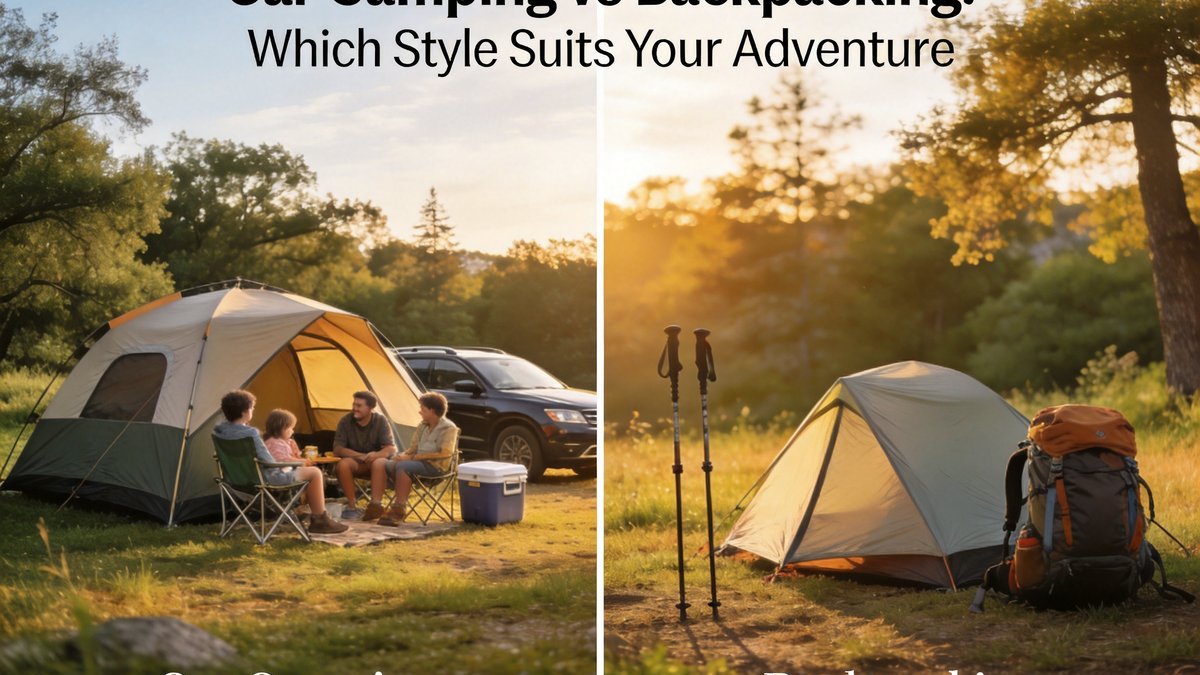
Compare car camping and backpacking to find your perfect outdoor adventure style. Learn about gear, costs, accessibility, and experience levels for each approach.
The outdoor world offers two distinct gateways into nature, each with its own philosophy, gear requirements, and rewards. Car camping welcomes you with open arms and a cold drink from the cooler. Backpacking challenges you to earn your views one step at a time. Understanding the differences helps you choose the right path for your current goals.
Car camping and backpacking represent fundamentally different approaches to experiencing the outdoors. Car camping involves driving to a campsite where your vehicle serves as your base camp. You can bring coolers, camp chairs, large tents, and as much gear as your car can hold. Backpacking means carrying everything you need on your back, traveling from one point to another on foot, and sleeping wherever you end the day. The distance between your car and your campsite might be a few steps for car camping or 10 miles for backpacking. This single difference cascades into every other aspect of the experience, from gear choices to meal planning to the types of places you can reach.
Car camping welcomes beginners with minimal gear investment. A basic tent, sleeping bag, and sleeping pad suffice for a first trip, and you can supplement with household items like pillows, blankets, and kitchen gear. Total startup costs for car camping run $200 to $500 for quality gear that lasts for years. Backpacking demands lighter, more compact, and more specialized equipment that costs significantly more. Backpacking tents weigh under 4 pounds compared to car camping tents that can weigh 10 pounds or more. Backpacking sleeping bags use higher-quality down or synthetic insulation to save weight. A full backpacking gear setup ranges from $800 to $2,000 for reliable equipment.
Car camping offers unparalleled accessibility. Families with young children, seniors, people with disabilities, and beginners can all enjoy camping without the physical demands of carrying gear. Thousands of established campgrounds across the country provide amenities like running water, flush toilets, picnic tables, and fire rings. National parks, state parks, and national forests all maintain car-accessible campgrounds that put you close to major attractions. Backpacking unlocks remote wilderness that car campers never see. Alpine lakes, ridgeline campsites, valleys deep in protected wilderness areas, and mountain passes all reward backpackers willing to carry their home on their backs. The solitude and sense of accomplishment from reaching a backcountry campsite creates a connection to the landscape that car camping cannot replicate.
Consider your current fitness level, available time, and goals when choosing between the two styles. If your primary goal is relaxing with family, cooking elaborate camp meals, and exploring day hikes from a base camp, car camping serves you perfectly. If you seek solitude, physical challenge, and the reward of reaching places few people visit, backpacking calls your name. Many outdoor enthusiasts enjoy both styles for different occasions. A typical season might include several car camping trips with family and one or two backpacking trips for personal challenge. Start with car camping to build foundational skills like tent setup, camp cooking, and outdoor navigation. Graduate to overnight backpacking on well-maintained trails before attempting multi-day treks in remote wilderness.
Car camping is about bringing the comforts of home to the outdoors. Backpacking is about leaving home behind entirely. One extends your living room into the forest. The other strips life down to what fits on your back. Both are valid. Both are valuable.
If you are unsure which style suits you, try this progression: two car camping trips to learn basic skills, one overnight backpack on an easy trail with a rented pack, then decide. Most people discover their preference through experience.
Absolutely. Many campgrounds near trailheads allow you to set up a base camp, then take day hikes or lightweight overnight backpacking trips from there. This hybrid approach lets you enjoy car camping comforts while exploring backcountry trails without carrying all your gear.
Backpacking generally offers better photography opportunities because you reach remote landscapes that car campers cannot access. Sunrise from a mountain ridgeline campsite or stars over an alpine lake require carrying your camera gear to those locations. Car camping works well for wildlife photography near established roads and scenic overlooks.
Try this test: load a day pack with 15 to 20 pounds and hike 3 to 5 miles on a moderate trail. If you complete this comfortably, you are ready for an overnight backpacking trip with a full pack of 25 to 35 pounds. Build up gradually by taking progressively longer day hikes with heavier packs.
No. Any car with enough space for your gear and passengers works for car camping on paved or well-maintained gravel roads. A sedan with folding rear seats carries plenty of gear for two people. SUVs, trucks, and vans offer additional space but are not required for a successful car camping trip.
Developing a consistent navigation routine keeps you oriented throughout the day. Every time you stop for a water break or snack, pull out your map and identify your current location. Note the next landmark you expect to see and the approximate time to reach it. This habit of regular map checks prevents the gradual disorientation that leads to getting lost. Experienced hikers recommend taking a bearing every 30 to 45 minutes in unfamiliar terrain, even when the trail seems obvious.
Before any hike, study the route on a map and identify key waypoints, bailout points, and potential hazards. Note the direction of ridges, valleys, and water features so you can use them as natural handrails. Share your planned route with someone who will notice if you do not return on time. Proper pre-trip planning transforms a potentially stressful navigation challenge into an enjoyable day on the trail.
When hiking in a group, designate a dedicated navigator rather than assuming everyone knows the route. This prevents the common scenario where each person thinks someone else is leading. At every junction, confirm the correct direction as a group before proceeding. A quick group check takes thirty seconds but can save hours of backtracking if the wrong turn is taken.
Developing a consistent navigation routine keeps you oriented throughout the day. Every time you stop for a water break or snack, pull out your map and identify your current location. Note the next landmark you expect to see and the approximate time to reach it. This habit of regular map checks prevents the gradual disorientation that leads to getting lost. Experienced hikers recommend taking a bearing every 30 to 45 minutes in unfamiliar terrain, even when the trail seems obvious.
Before any hike, study the route on a map and identify key waypoints, bailout points, and potential hazards. Note the direction of ridges, valleys, and water features so you can use them as natural handrails. Share your planned route with someone who will notice if you do not return on time. Proper pre-trip planning transforms a potentially stressful navigation challenge into an enjoyable day on the trail.
When hiking in a group, designate a dedicated navigator rather than assuming everyone knows the route. This prevents the common scenario where each person thinks someone else is leading. At every junction, confirm the correct direction as a group before proceeding. A quick group check takes thirty seconds but can save hours of backtracking if the wrong turn is taken.
Developing a consistent navigation routine keeps you oriented throughout the day. Every time you stop for a water break or snack, pull out your map and identify your current location. Note the next landmark you expect to see and the approximate time to reach it. This habit of regular map checks prevents the gradual disorientation that leads to getting lost. Experienced hikers recommend taking a bearing every 30 to 45 minutes in unfamiliar terrain, even when the trail seems obvious.
Before any hike, study the route on a map and identify key waypoints, bailout points, and potential hazards. Note the direction of ridges, valleys, and water features so you can use them as natural handrails. Share your planned route with someone who will notice if you do not return on time. Proper pre-trip planning transforms a potentially stressful navigation challenge into an enjoyable day on the trail.
When hiking in a group, designate a dedicated navigator rather than assuming everyone knows the route. This prevents the common scenario where each person thinks someone else is leading. At every junction, confirm the correct direction as a group before proceeding. A quick group check takes thirty seconds but can save hours of backtracking if the wrong turn is taken.