Table of Contents
Water safety knowledge is the foundation of enjoyable paddling. Understanding currents, hazards, and rescue techniques keeps you and your companions safe on every outing.
Jordan Myers
Water safety knowledge is the foundation of enjoyable paddling. Understanding currents, hazards, and rescue techniques keeps you and your companions safe on every outing.
Water safety knowledge is the foundation of enjoyable paddling. Understanding currents, hazards, and rescue techniques keeps you and your companions safe on every outing.
River currents follow predictable patterns based on water volume, gradient, and channel shape. Water flows fastest on the outside of bends and slowest on the inside. This creates eddies behind obstacles where water flows upstream. Reading these patterns allows paddlers to navigate efficiently and avoid danger. The ability to read current is the foundation of all whitewater skills.
Strainers are among the most dangerous river hazards. A strainer is an obstacle that allows water to pass through but traps solid objects including boats and people. Fallen trees, bridge pilings, and wire fences create strainers. Never approach a strainer from upstream. If you are being pulled toward a strainer, aggressively paddle away or abandon your boat and swim away from the obstacle.
Hydraulics or holes form when water flows over a submerged obstacle and recirculates. Hydraulic features range from gentle wave trains to powerful recycling holes that can hold a boat or swimmer indefinitely. Most hydraulics are visible as a line of aerated white water with a smooth, boiling surface below the drop. Avoid powerful hydraulics and scout unfamiliar rapids before running them.
Visual signals communicate between paddlers when verbal communication is impossible due to rapid noise. The stop signal involves raising your paddle horizontally overhead with both hands. The go signal points downstream with your paddle. The OK signal forms a circle with your hand overhead. The emergency signal waves both arms overhead. Learn these signals before your first river trip.
Auditory signals supplement visual signals for close communication. A whistle provides a standardized signaling system: one blast means attention, two blasts means stop, three blasts means emergency. Whistles carry farther than voices and remain effective even when you are out of breath. Attach your whistle to your PFD with a short lanyard for quick access.
Group communication protocols keep everyone informed and safe. Call out your intentions before making moves. Announce obstacles to paddlers behind you. The lead boat sets the pace and calls out route choices. The sweep boat ensures no one is left behind. Every paddler in the group shares responsibility for communication and hazard awareness.
Swimming in moving water requires different techniques than pool swimming. Float on your back with your feet pointed downstream to absorb impacts and watch for obstacles. Use your feet to push off rocks rather than trying to stand. Angle your body toward shore while keeping your feet downstream. Never try to stand in current deeper than your knees as foot entrapment is a serious hazard.
The defensive swimming position protects you while floating through rapids. Lie on your back with feet downstream, knees slightly bent, and hands visible for paddling to avoid obstacles. Keep your head up and look downstream to anticipate upcoming hazards. Relax and breathe during long swims to conserve energy. Your PFD provides flotation, so focus on positioning and breathing.
Throw rope rescue is the standard technique for assisting swimmers. Practice throwing your rope bag accurately before you need it in an emergency. Aim past the swimmer so the rope lands across their path. Call Rope before throwing to get their attention. The swimmer should grab the rope and roll onto their back, feet downstream while being pulled to shore. Never tie the rope to yourself as it may pull you into the current.
The T-rescue for kayaks and canoes allows a capsized paddler to be re-entered on the water. A rescuer positions their boat perpendicular to the capsized boat, lifts the bow to drain water, and stabilizes the boat while the swimmer re-enters. Practice this rescue in calm water before attempting it in current. The T-rescue requires coordination between rescuer and swimmer.
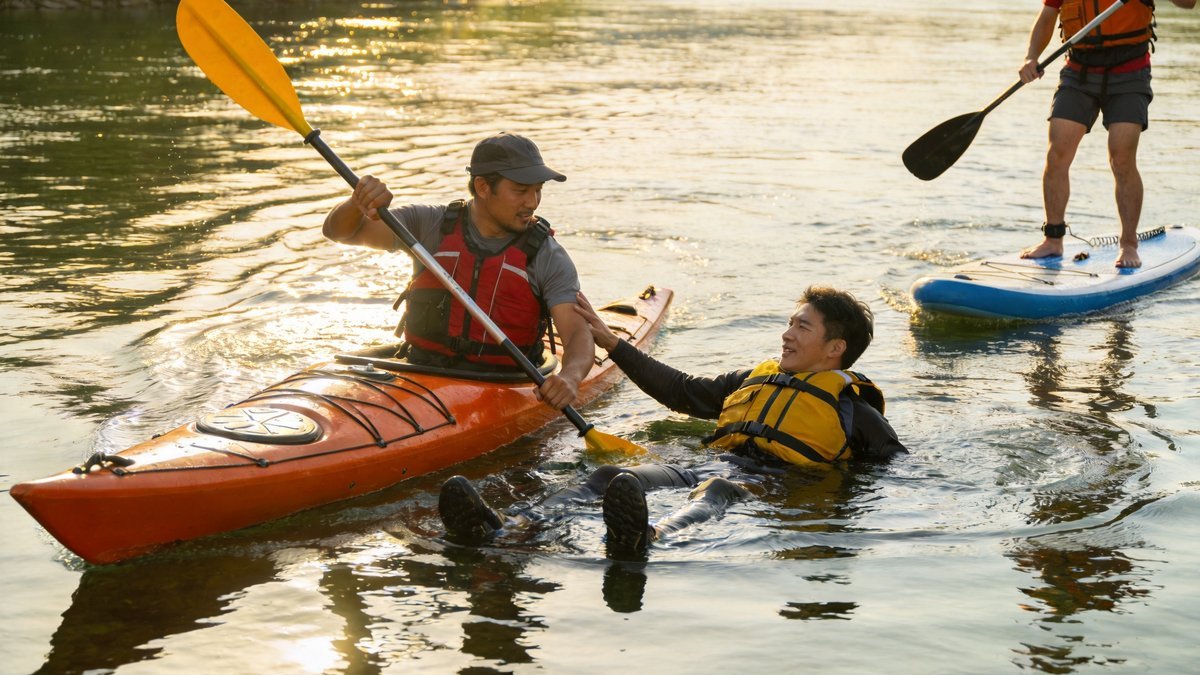
Boat-assisted rescue for swimmers involves maneuvering your boat alongside the swimmer and helping them re-enter or hold onto the boat until reaching shore. Approach the swimmer from upstream, allowing the current to bring them alongside. Keep the swimmer on the upstream side of your boat to avoid pinning them against rocks. Communicate clearly throughout the rescue process.
Live bait rescue is a last-resort technique used when a swimmer is trapped in dangerous water and cannot self-rescue. A rescuer enters the water intentionally to reach the trapped person. This technique carries significant risk and should only be attempted by trained rescuers with appropriate safety equipment and backup plans. Never attempt live bait rescue without swiftwater rescue training.
Prevention is the most effective safety strategy. Research river difficulty, flow levels, and hazard reports before every trip. Check current flow rates on USGS gauges and understand how flow affects specific rapids. Scout every rapid from shore before running it, especially on unfamiliar rivers. The time invested in scouting prevents the most common river accidents.
Group size affects safety on the river. The minimum group size for whitewater paddling is three boats. This ensures that if one person swims, one rescuer can assist while the third goes for help if needed. Larger groups require clear communication protocols and designated lead and sweep boats. Groups larger than 10 boats should split into smaller pods with their own leadership.
Weather awareness prevents many river incidents. Rain upstream can raise river levels rapidly even when the sun is shining at your put-in. Lightning poses serious risk to paddlers on open water. Cold fronts dropping temperatures can transform a pleasant paddle into a hypothermia emergency. Check the complete forecast including upstream weather before every trip.
"The river does not care how many times you have run this rapid or how experienced your group is. Every lap is a new test of your skills, judgment, and humility. Approach each rapid with the respect it deserves."
"The best rescue is the one that never needs to happen. Good judgment, proper equipment, and conservative decision-making prevent more accidents than all the rescue techniques in the world combined."
The most common river injuries result from foot entrapment when paddlers try to stand in moving water. Never stand in current deeper than your knees. Float on your back with feet pointed downstream until you reach calm, shallow water or can swim safely to shore. Foot entrapment can pin you underwater even in moderately swift current.
Research the river classification, current flow level, and recent hazard reports before your trip. Choose rivers with Class I-II rapids for beginners. Progress to Class III after developing solid self-rescue skills and river reading ability. Consult guidebooks, online forums, and local paddling clubs for current conditions and recommendations.
If a paddler is missing, immediately establish a search plan. The group should stop at a safe location and conduct a visual search of the river downstream. If the missing person is not found within 15 minutes, designate one person to go for emergency help while others continue searching. Note the last known location and time.
Solo paddling carries significantly higher risk than group paddling. If you paddle alone, choose rivers well within your skill level, wear your PFD at all times, carry communication devices, and leave a detailed trip plan with someone on shore. Most paddling safety organizations recommend against solo paddling on rapids above Class II.
Safety on the water begins before you launch. Always wear a properly fitted personal flotation device, regardless of your swimming ability or water conditions. Check weather forecasts and river flow rates before every trip. File a float plan with someone on shore that includes your route, expected return time, and vehicle details. In cold water conditions, wear appropriate insulation even in warm air temperatures to prevent shock and hypothermia.
Efficient paddling technique reduces fatigue and increases your enjoyment on the water. Engage your core muscles rather than relying solely on arm strength for each stroke. Rotate your torso with each paddle stroke to engage larger muscle groups. Keep your top hand at eye level during forward strokes for optimal leverage. Practice your strokes on flat water before moving to moving water, where good technique becomes essential for safety and control.
Understanding how to read river features keeps you safe and helps you choose the best line through rapids. Look for the V shape where water flows deepest between rocks. Avoid the dark pillow shapes that indicate submerged boulders pushing water upward. Learn to identify eddies behind obstacles where you can rest and scout the next section. In tidal areas, study tide charts and understand how tidal flows affect water levels and current direction throughout the day.