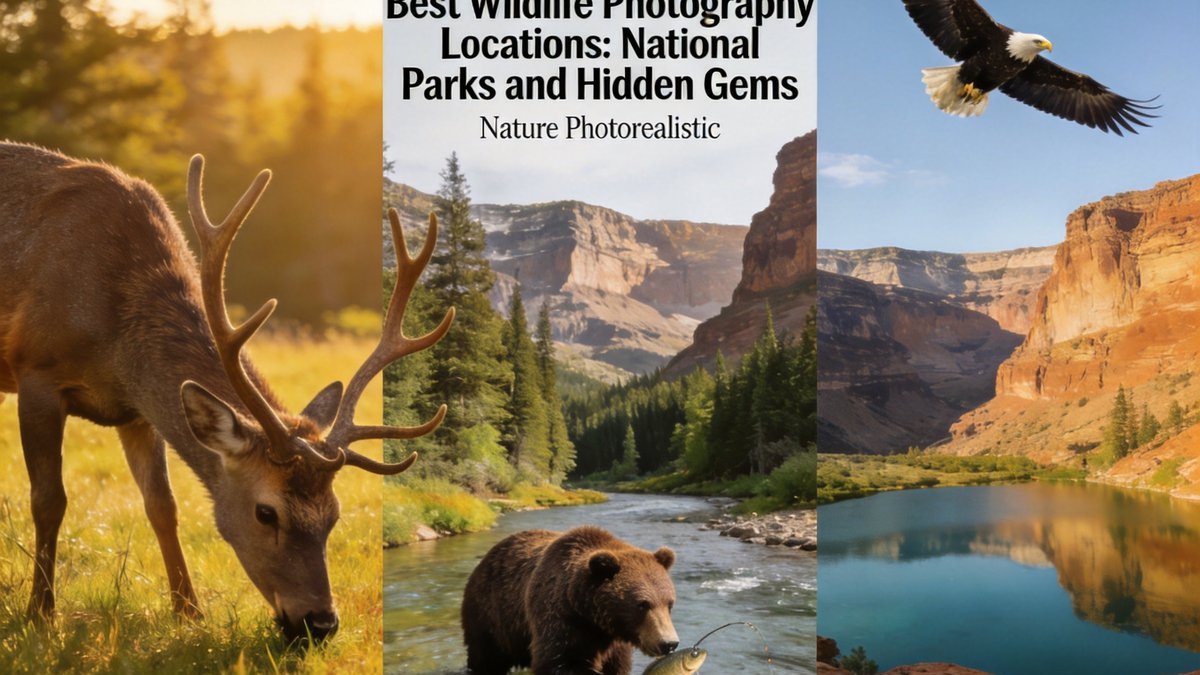
Discover the best wildlife photography locations in North America from iconic national parks to hidden gems for capturing amazing nature photos.
Yellowstone National Park: The Ultimate Wildlife Destination
Yellowstone National Park is arguably the finest wildlife photography destination in North America. The park hosts the greatest concentration of mammals in the lower 48 states, including bison, elk, wolves, grizzly bears, black bears, pronghorn, bighorn sheep, and coyotes. The Lamar Valley, known as America's Serengeti, offers reliable sightings of wolves, bison, and bears against stunning mountain backdrops.
Early morning and late evening are prime photography times in Yellowstone. Hayden Valley and the Madison River area offer exceptional opportunities for photographing bison herds, elk, and waterfowl. Winter brings a different dimension with steaming geothermal features framing snow-covered wildlife. The park's northern range remains accessible year-round, offering winter wolf and bison photography.
Yellowstone in winter is a wildlife photographer's paradise. The crowds are gone, the geothermal features create atmospheric steam in the cold air, and the animals are more visible against the snow. It is challenging conditions for gear and photographer alike, but the images are incomparable.
Denali National Park: Wilderness at Its Finest
Denali National Park in Alaska offers wildlife photography in a true wilderness setting. The park is home to grizzly bears, wolves, moose, caribou, Dall sheep, and foxes. The single park road provides access to exceptional wildlife viewing opportunities, and the absence of development creates pristine backgrounds for photographs. Denali's vast landscape provides context that smaller parks cannot match.
The best time for wildlife photography in Denali is June through August when animals are active, young are present, and the weather is most cooperative. Brown bears can be observed feeding on berries along the park road. Caribou herds migrate through the park, and Dall sheep are visible on mountain slopes. The midnight sun provides extended shooting hours.
Everglades National Park: Subtropical Wildlife Diversity
Everglades National Park in Florida offers a completely different wildlife photography experience focused on subtropical and wetland species. Alligators, crocodiles (the only place both species coexist), wading birds, manatees, and the elusive Florida panther call the park home. The Anhinga Trail is one of the best wildlife photography boardwalks in the world, with consistently close views of birds, alligators, and turtles.
Winter dry season (November through April) concentrates wildlife around remaining water sources, creating exceptional photography opportunities. The park's mangrove estuaries offer kayak-based photography access to birds and marine life. Shark Valley provides a 15-mile loop trail with excellent wildlife viewing by tram, bike, or on foot.
Lesser-Known Wildlife Photography Gems
Beyond the famous national parks, numerous hidden gems offer outstanding wildlife photography with fewer crowds. The J.N. Ding Darling National Wildlife Refuge on Sanibel Island, Florida, provides exceptional bird photography from an auto tour route. Bosque del Apache National Wildlife Refuge in New Mexico hosts thousands of sandhill cranes and snow geese during winter months.
The Apostle Islands National Lakeshore in Wisconsin offers unique opportunities for photographing black bears along the shoreline and a remarkable population of wolves on the islands. The Channel Islands National Park off the California coast provides boat-based access to unique island-endemic species including island foxes and island scrub-jays.
Planning Your Wildlife Photography Trip
Research is the foundation of a successful wildlife photography trip. Study species behavior patterns specific to your destination. Identify the best season for your target species. Check recent sightings reports on eBird and iNaturalist. Book accommodations well in advance for popular parks, as lodging fills months ahead during peak seasons.
Pack for the specific conditions of your destination. Remote locations require self-sufficiency in food, water, and gear. Consider hiring a local guide for your first visit to a new location. Guides with local knowledge dramatically increase your efficiency in finding and photographing wildlife. The cost of a guide is often offset by the images you will capture in less time.
For Yellowstone’s Lamar Valley, a 500mm f/4 lens from Canon or Nikon is the standard for capturing wolves at ethical distances, but a 1.4x teleconverter can add reach without breaking the bank. The Specimen Ridge Trail, a 9-mile out-and-back, offers elevated views of bison and pronghorn during the June calving season. A sturdy tripod like the Gitzo Systematic series is essential for sharp images in the low light of dawn, while a rain cover from Think Tank protects gear from sudden snow squalls. Photographers should set shutter speeds to at least 1/1000th of a second for moving predators, using aperture priority at f/8 to balance depth of field with subject isolation.
Denali’s Polychrome Overlook, accessible via the 92-mile park road at mile 46, provides a prime vantage for photographing grizzly bears digging for roots on the tundra in July. A 100-400mm zoom lens from Sony is ideal for the ever-changing distances to caribou herds moving across the Savage River Loop, a 2-mile trail near the park entrance. Using a beanbag draped over the vehicle window stabilizes long glass for shots from the park bus, a technique that minimizes camera shake on the gravel road. Spotting scopes like the Swarovski ATX 95 help locate Dall sheep on the cliffs above the Teklanika River before committing to a hike.
At Everglades’ Anhinga Trail, a 0.8-mile boardwalk, a polarizing filter reduces glare off the water to reveal the iridescent feathers of purple gallinules and the scales of alligators basking at 10 feet. The Snake Bight Trail, a 3.6-mile round trip through mangroves, offers sunrise shots of roseate spoonbills feeding in the shallows, best captured with a telephoto lens at 400mm and ISO 800 to freeze wing motion. A kayak from the Flamingo Marina allows photographers to drift silently within 20 feet of manatees in the winter months, using a waterproof housing like the AquaTech Elite for a mirrorless camera. For the elusive Florida panther, the Main Park Road at dawn near the Nine Mile Pond area yields rare sightings, requiring a 600mm lens and patience for hours of glassing the forest edge.
Bosque del Apache’s 15-mile auto tour loop in New Mexico is a winter gem, where the Flight Deck overlook at mile 7 provides a clear view of sandhill cranes lifting off at sunrise. A 200-600mm zoom from Sigma on a monopod allows quick adjustments for the fast-moving snow geese flocks, using burst mode at 10 frames per second to capture wing positions. The J.N. Ding Darling Refuge’s 4-mile Wildlife Drive, best visited two hours before low tide, concentrates herons and egrets along the mudflats for close-ups with a 70-200mm lens. The Apostle Islands’ Meyers Beach Sea Cave Trail, a 2-mile hike, leads to shoreline bluffs where black bears forage in June, requiring a 300mm f/2.8 lens and early morning light to separate the bear from the dark forest background.
For wolf photography, stake out the Lamar Valley at dawn with a 500mm f/4 lens on a sturdy Gitzo tripod—the low-angle light paints the pack's fur in golden hues. Use a fast shutter speed of 1/2000th second to freeze a sprinting coyote or a bison's breath in the frosty November air. Arrive before 6 AM at the Slough Creek trailhead for prime bison calf shots against steam rising from the river.
Venture beyond Yellowstone to the Boundary Waters Canoe Area Wilderness for moose in their element. Paddle a Kevlar canoe silently through the mist on Moose Lake, keeping your camera in a waterproof Pelican case until you spot antlers breaking the surface. Set your aperture to f/8 at 1/500th second to capture the moose's velvet-covered antlers against a backdrop of pines and granite outcrops.
In Great Smoky Mountains National Park, hike the Alum Cave Trail to Myrtle Point for black bear cubs foraging in spring rhododendron blooms. Use a 70-200mm f/2.8 lens at eye level, crouching in the damp leaf litter to avoid spooking them. Focus on the bear's eye with back-button autofocus, and expose for the highlights to keep the black fur from blowing out in the dappled light.