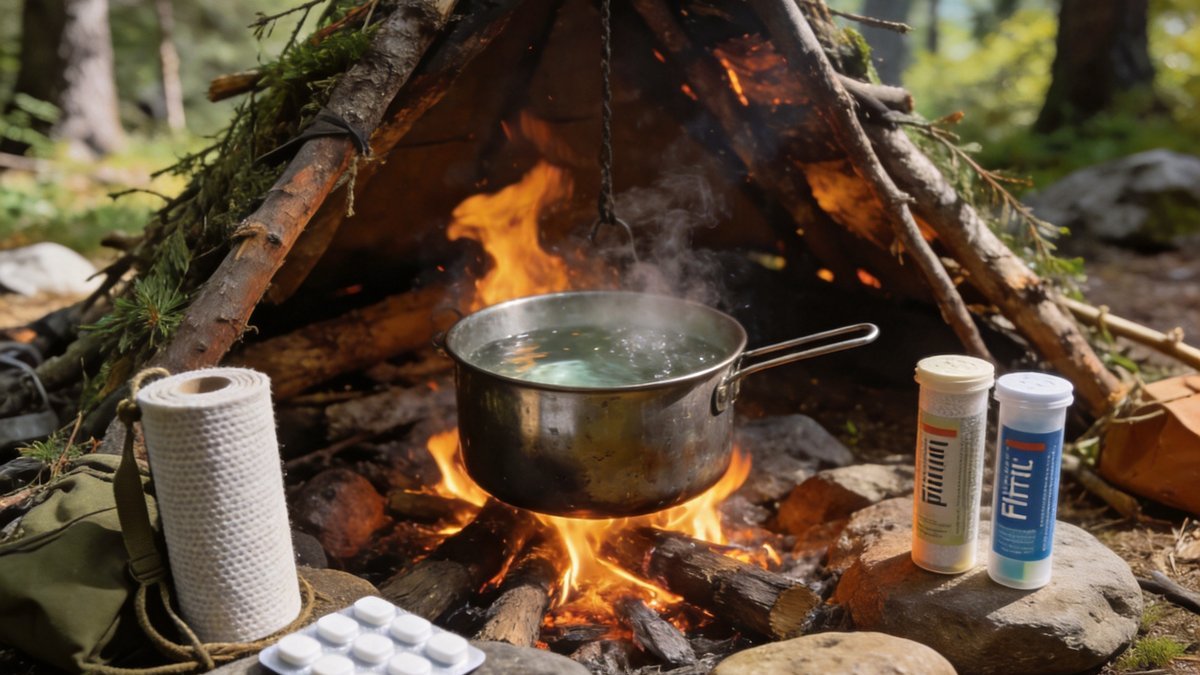
Access to clean drinking water is the most immediate survival priority. Water sources in the wilderness may appear clean but harbor microscopic pathogens. Understanding multiple purification methods ensures you can safely hydrate regardless of your equipment.
Key Takeaways
- Boiling is the most reliable method. Rolling boil for one minute (three minutes above 6,500 feet) kills all pathogens.
- Water filters remove bacteria and protozoa. Most portable filters do not remove viruses. Add chemical treatment for virus protection.
- UV purifiers work in clear water but require pre-filtration for cloudy water. They run on batteries that can fail in cold.
- Chemical tablets are lightweight and effective but leave aftertaste. They take 30 minutes to 4 hours depending on temperature.
Boiling: The Gold Standard
Boiling kills all waterborne pathogens without exception. Bring water to a rolling boil for one minute at sea level, three minutes above 6,500 feet. Boiling does not remove chemical contaminants or improve taste. Allow water to cool before drinking. Improve flat taste by pouring between containers to aerate. Boiling requires fuel, consuming resources that may be limited.
Portable Water Filters
Portable water filters remove bacteria and protozoa through physical filtration. The Sawyer Squeeze uses 0.1-micron hollow fiber membrane technology filtering 100,000 gallons. Pump filters like the MSR Guardian provide faster flow rates. Gravity filters like the Platypus work well for base camp. Most portable filters do not remove viruses. In North America, virus risk is minimal. Internationally, combine filtration with chemical treatment.
Chemical Purification
Aquamira chlorine dioxide drops provide effective treatment against bacteria, viruses, and protozoa. Treatment time ranges from 30 minutes in warm water to 4 hours in cold water. Chemical treatment is the lightest option, with a single bottle treating 30 gallons. Iodine tablets kill most pathogens but leave strong taste. Chlorine dioxide has less aftertaste. Chemical effectiveness decreases in cold water.
UV Purification and Natural Methods
UV purifiers like SteriPen use ultraviolet light to disrupt pathogen DNA. A 90-second stir treats one liter. UV requires clear water for effective penetration. Pre-filter cloudy water through a bandana. Solar disinfection uses sunlight: fill clear bottles and place in direct sun for 6 hours. These methods provide partial treatment and should only be used when no other option exists.
| Method | Effectiveness | Weight | Time | Pros | Cons |
|---|---|---|---|---|---|
| Boiling | Kills all pathogens | Pot only | 1-3 min | Reliable, no equipment | Requires fuel, time to cool |
| Pump Filter | Removes bacteria + protozoa | 3 oz | Fast | Instant clean water | Does not remove viruses |
| UV Purifier | Kills all pathogens | 3.5 oz | 90 sec | Fast, no pumping | Batteries, pre-filter needed |
| Chemical Tablets | Kills all pathogens | 1 oz | 30 min+ | Lightest option | Aftertaste, slow in cold |
| Gravity Filter | Removes bacteria + protozoa | 11 oz | Passive | Large volume | Heavier, slow for small amounts |
Clear mountain water is not safe to drink untreated. The most pristine-looking stream can harbor Giardia and Cryptosporidium. Water clarity has zero correlation with microbiological safety. Treat every backcountry water source.
When choosing a water treatment method, consider trade-offs. Boiling is most reliable but consumes fuel. Filters are fast but require maintenance. Chemicals are lightest but slow. Combine methods for best protection.
Water Storage and Hydration Management
Proper water storage is as important as purification. Collapsible water bottles and hydration bladders like the Platypus or Sawyer squeeze bags save pack space when empty. Hard-sided Nalgene bottles provide durability and can hold boiling water for emergency sterilization. A 2-liter capacity is the minimum for day hikes. Carry 3-4 liters for multi-day trips in dry areas. Water weighs 2.2 pounds per liter, so carrying more than one day's supply quickly becomes heavy. Plan your route to pass reliable water sources at least every 5-8 miles in most terrain.
Monitor your hydration status throughout the day. Clear or light yellow urine indicates adequate hydration. Dark yellow urine means you need to drink more. Set a timer to drink every 15-20 minutes during active hiking rather than waiting until you feel thirsty. By the time thirst registers, you are already mildly dehydrated. Add electrolyte tablets to your water during hot conditions or heavy exertion to replace sodium, potassium, and magnesium lost through sweat. Brands like Nuun, Liquid IV, and Tailwind offer effective formulations that dissolve without leaving residue in your bottles or bladder.
Emergency Water Sources and Collection Techniques
When regular water sources are unavailable, several emergency techniques provide water. Rainwater collection using a tarp or rainfly channels clean water into containers. In arid environments, solar stills can extract moisture from vegetation using a covered hole with a collection container at the bottom. Morning dew collected from vegetation with a bandana can provide small amounts of water. These methods produce limited quantities and should only be relied upon in genuine emergencies with no other options available.
Recognizing safe water sources requires careful judgment. Fast-moving water from high-elevation streams carries lower pathogen risk than slow, warm lowland water. Water from snowmelt sources above treeline is generally safer than lowland water. Avoid water sources downstream from campsites, grazing areas, or mining operations. Clear water is not necessarily safe water; the most pristine-looking alpine stream can harbor Giardia cysts that cause severe gastrointestinal illness for weeks. Always treat every backcountry water source, regardless of how clean it appears. The 10 minutes you spend filtering or boiling water is nothing compared to 10 days of giardiasis symptoms.
Chemical Treatment Methods and Their Limitations
Chemical water treatment offers a lightweight, simple alternative to filters and boiling. Iodine tablets are the most compact purification option, requiring a 30-minute wait time in clear water and 60 minutes in cold or cloudy water. Iodine kills bacteria and viruses but is not effective against Cryptosporidium, a protozoan parasite found in many wilderness water sources. Iodine also imparts an unpleasant taste and is not suitable for long-term use. Chlorine dioxide tablets, such as Katadyn Micropur, are effective against a wider range of pathogens including Cryptosporidium, with a four-hour wait time for full treatment.
Chemical treatment has several important limitations. Cold water significantly slows the purification process, requiring double or triple the standard treatment time. Cloudy water requires pre-filtering through a bandana or coffee filter before treatment, as suspended particles can shield organisms from chemical contact. The shelf life of chemical tablets is limited, typically one to two years when stored properly, and expired tablets lose effectiveness. Some people experience gastrointestinal sensitivity to chemical treatments. Combining chemical treatment with pre-filtering provides reliable protection for most backcountry water sources, though chemical methods are not recommended as the sole treatment in areas with known agricultural runoff or heavy animal use.
UV Light Purification Systems
UV light purifiers use ultraviolet radiation to destroy the DNA of microorganisms, rendering them harmless. Devices like the SteriPEN weigh under 4 ounces and treat a liter of clear water in 90 seconds, making them one of the fastest and most convenient purification methods available. UV treatment is effective against bacteria, viruses, and protozoa including Giardia and Cryptosporidium when used correctly. The technology has no chemical taste, requires no pumping, and uses rechargeable or replaceable batteries that last for dozens of treatments per charge.
The main limitations of UV treatment are battery dependency and water clarity requirements. Turbid or cloudy water blocks UV light from reaching microorganisms, requiring pre-filtering before treatment. The device must be fully submerged with the UV bulb completely covered by water to ensure proper treatment. Batteries fail in cold weather, reducing treatment capacity significantly below freezing. UV devices are also more fragile than chemical or filter-based systems, with the quartz bulb being particularly vulnerable to breakage. For these reasons, UV treatment works best as a primary method for clear water sources with a chemical backup for cloudy conditions or when batteries are low.
Frequently Asked Questions
Can I get sick from untreated wilderness water?
Yes. Giardia, Cryptosporidium, and E. coli cause severe diarrhea and vomiting that can incapacitate you. Always treat wilderness water regardless of appearance.
How do I know if my filter is working?
Signs of failure include dramatically reduced flow after cleaning, visible damage, or water passing around the filter seal. Replace elements per manufacturer recommendations.
Is snow a safe water source?
Snow is generally safe from biological contaminants. Melt before drinking since eating snow lowers body temperature. Collect clean white snow away from trails.
How much water do I need per day?
Plan for at least one gallon per person per day. Increase in hot conditions, high altitude, or during strenuous activity.